Last updated 2026-08-17
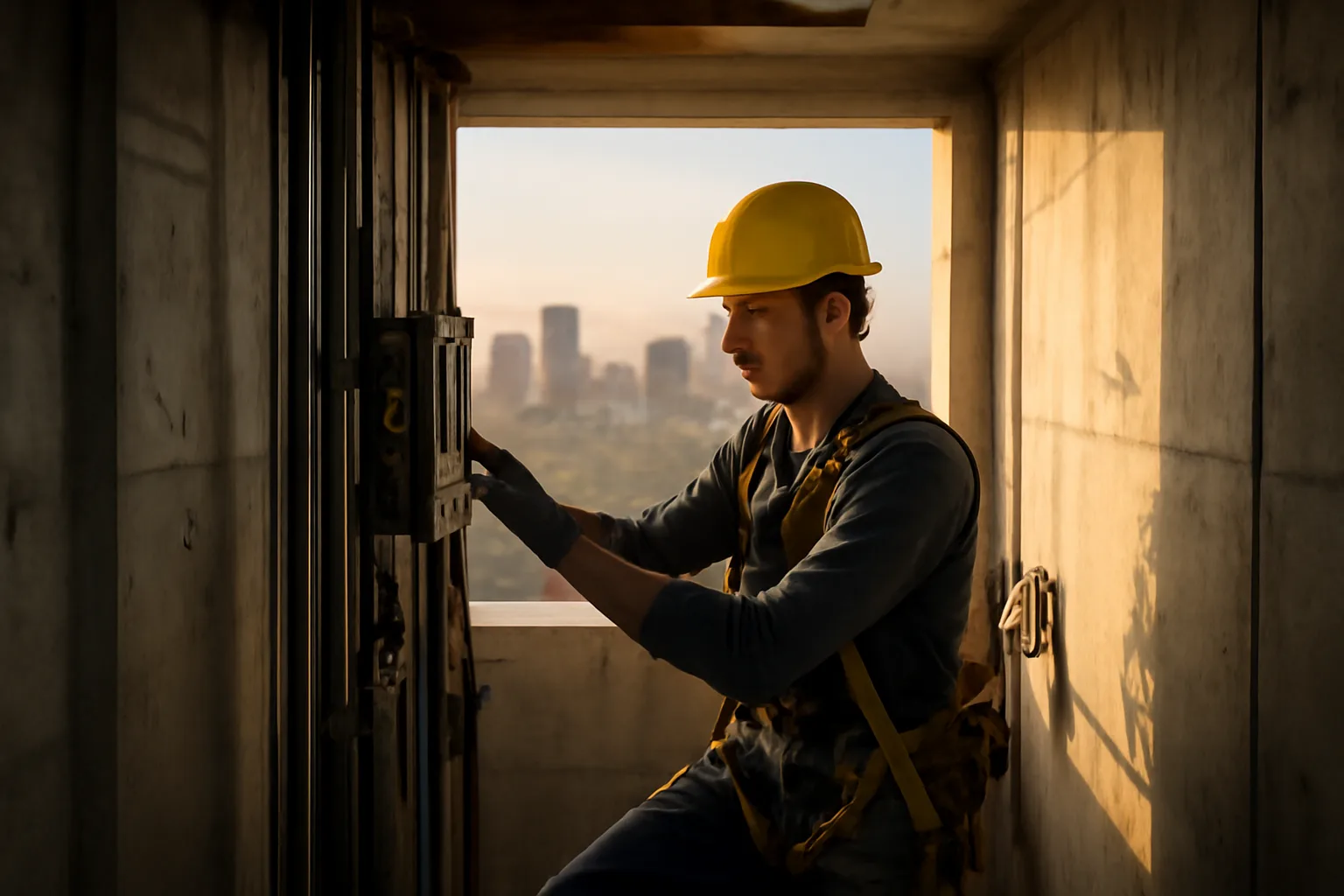
TL;DR
Arizona requires a state elevator mechanic certificate before you touch an elevator. You get there through a four-year IUEC Local 140 apprenticeship, registered with the state apprenticeship office, that pays you from day one. First-year out-of-pocket costs run roughly $500 to $1,500 for tools, boots, and dues. Plan on four to five years from your first application to a journeyman card.
Do you need a license to be an elevator mechanic in Arizona?
Yes. You cannot legally work on elevators in Arizona without a valid state certificate. The Arizona Department of Fire, Building and Life Safety (DFBLS) administers elevator safety under the Elevator Safety Act, codified at Arizona Revised Statutes 23-491 through 23-491.12 [1]. Those statutes require anyone who installs, alters, or maintains an elevator to hold a valid elevator mechanic certificate.
There is a second credential in play, and it belongs to your employer. The Arizona Registrar of Contractors (ARC) licenses the elevator companies that hire mechanics [2]. So a job site needs two things in place before work starts: the contractor's ARC license and each mechanic's personal DFBLS certificate.
Keep the two straight. The contractor license is your employer's problem. Your certificate is yours alone, and no employer can wave you past the requirement.
What is the actual path to becoming a licensed elevator mechanic in Arizona?
The real path is a Joint Apprenticeship Training Committee (JATC) program run by International Union of Elevator Constructors (IUEC) Local 140, which covers Arizona. The apprenticeship runs four years and mixes paid on-the-job training with classroom instruction [3]. You finish with enough documented hours to sit the National Elevator Industry Educational Program (NEIEP) competency evaluation, and once you pass, you apply for your Arizona certificate.
Here is how the sequence works in practice:
1. Apply to IUEC Local 140 during an open application period. These windows are not always open. The local posts them when contractor demand in the Phoenix and Tucson markets calls for new apprentices. 2. Pass the aptitude test and interview. The test covers basic algebra and mechanical reasoning. Nothing exotic, but take it seriously. 3. Get dispatched to a signatory contractor. You don't pick your employer off a menu. The union dispatches you based on work availability. 4. Register the apprenticeship with the Arizona State Apprenticeship Office under the Arizona Department of Economic Security, which satisfies the federal Department of Labor registered apprenticeship requirement [4]. 5. Complete four years of on-the-job training (OJT) hours alongside NEIEP coursework, delivered online through the union's training platform. 6. Pass the journeyman examination and apply for your DFBLS elevator mechanic certificate.
From first application to journeyman certificate, plan on four to five years. The application-to-dispatch gap alone can run several months if the local's books aren't wide open when you apply. Budget for that gap.
How long does it take to become an elevator mechanic in Arizona?
Four to five years is the honest answer for most people on the IUEC route. The apprenticeship itself is structured as four years of combined OJT and related technical instruction [3]. Add the wait between applying and getting dispatched, which runs anywhere from a few weeks to over a year depending on local demand, and five years is the more realistic planning horizon.
There is no fast-track licensure for someone starting cold. Arizona runs a reciprocity process, but it's built for already-licensed journeyman mechanics coming from another state, not first-timers. If you already hold a journeyman card elsewhere, confirm current reciprocity procedures directly with DFBLS. The details change, and the board is the only reliable source.
Here are the four apprenticeship years broken into rough phases:
| Year | Main Activity | What Changes |
|---|---|---|
| 1 | Basic code, rigging, job-site safety | Lowest apprentice wage rate |
| 2 | Hydraulic systems, traction systems | Wage steps up per CBA |
| 3 | Modernization, inspection prep | More solo work on site |
| 4 | Advanced troubleshooting, final coursework | Journeyman exam prep |
Your wage steps up each year under the collective bargaining agreement (CBA) between Local 140 and the signatory contractors. By year four you're earning a solid slice of the journeyman rate, which makes the back end of the apprenticeship far easier on your wallet than the front end.
How much does becoming an elevator mechanic cost in Arizona?
This is where a lot of career-change articles go vague and mislead people. Let's be specific about what actually costs money.
You are paid during the apprenticeship. That's the most important financial fact about this path. You aren't paying tuition to sit unpaid in a classroom. The NEIEP coursework comes out of your union dues, not a separate bill. The OJT hours are paid work hours.
What does cost money out of pocket:
- IUEC initiation fees and monthly dues. Apprentice initiation fees for Local 140 vary, so confirm the current figure with the local. Apprentice dues run lower than journeyman rates. Budget roughly $50 to $100 per month as a planning estimate, then verify the real number.
- Hand tools. The union and contractor supply most heavy equipment, but you show up with your own hand tool set. A solid starter set runs $300 to $800 depending on brand choices. You don't need top-shelf everything on day one.
- Steel-toed boots and PPE. Budget $150 to $250 for boots meeting the ASTM F2413 standard [5]. Gloves, hard hat, and safety glasses add another $50 to $100.
- Transportation. Arizona is a big state with sprawling metros. Get dispatched to a Phoenix suburban job site with no reliable ride, and that's a real problem.
First-year out-of-pocket estimate: $500 to $1,500, assuming you already own a vehicle. That covers tools, boots, and a year of dues. It leaves out transportation and any application fees, which you should confirm with Local 140.
For people still in the research phase who want the application and waiting-list process mapped out before they commit, ElevatorKit's IUEC Waiting-List Kit ($149 one-time at /start) lays out the paper path and timing in one place.
Longer term, journeyman elevator mechanics in Arizona earn well above the state median wage. The Bureau of Labor Statistics Occupational Employment and Wage Statistics (OEWS) program reported a mean annual wage of $99,870 for elevator and escalator installers and repairers nationally in May 2023, with Arizona tracking close to that mean [6]. The lean pay in years one and two is real. The journeyman rate makes the math work over a career.
What does IUEC Local 140 cover in Arizona?
IUEC Local 140 holds jurisdiction over elevator construction and maintenance work in Arizona. Its territory takes in the Phoenix metro, Tucson, and the surrounding regions. Work for a signatory elevator contractor anywhere in the state, and you're in Local 140's jurisdiction.
The local runs the JATC program alongside the contractors who signed the collective bargaining agreement. That JATC is your training infrastructure. It dispatches apprentices, tracks OJT hours, coordinates NEIEP coursework access, and manages the formal apprenticeship registration with the Arizona State Apprenticeship Office [4].
A few practical notes. The application process opens periodically, not on a fixed annual calendar. Checking the local's official channels is the only reliable way to catch an open window. Call the hall directly. Third-party job boards run stale information constantly.
The JATC also links you to the NEIEP training platform, which hosts the online coursework. You'll need reliable home internet to keep pace. That sounds obvious, but it's a genuine logistics problem for apprentices in some rural Arizona communities.
What are the Arizona elevator safety law requirements for mechanics?
Arizona's Elevator Safety Act, codified at ARS 23-491 through 23-491.12, is the statutory foundation [1]. The act requires certificates for mechanics and licenses for contractors. It gives DFBLS authority to write rules, conduct inspections, and enforce compliance.
The Arizona Administrative Code Title 4, Chapter 36 holds the rules that implement the act, including certificate applications, renewals, and what counts as covered elevator work [7]. Read those rules before you apply. They define which equipment types are covered (traction elevators, hydraulic elevators, escalators, moving walks, and others) and which minor maintenance tasks might sit outside the certificate requirement.
ARS 23-491.03 sets the core obligation, requiring that a person not install, alter, or maintain a conveyance unless that person holds a valid certificate issued by the director [1].
Certificates must be renewed. Renewal periods and fees change, so confirm the current requirements with DFBLS before your certificate expires. Let one lapse and you create real legal exposure, and reinstatement isn't always simple.
How does Arizona compare to neighboring states for elevator mechanic licensing?
Arizona has a fully codified elevator safety law and a state certificate requirement. That puts it in the same camp as California, Colorado, and Nevada, not the states with patchwork or no statewide licensing.
How to start as an elevator mechanic in California and how to start as an elevator mechanic in Colorado both run through similar four-year IUEC apprenticeships with state certificate requirements, so the pathway structure holds steady across the Southwest. The wage scales, fees, and processing timelines differ by state.
Already licensed in another state and want to work in Arizona? Ask about reciprocity early. Some states have agreements with Arizona; others don't. DFBLS is the authority on current status. Don't take a recruiter's word for it.
For a wider comparison, elevator mechanic licensing in Alaska runs on a similar state certificate structure but a different union local and a very different job market. Seeing how the paper path shifts state to state helps if you're weighing where to start.
What basic qualifications do you need to apply for an elevator mechanic apprenticeship in Arizona?
The IUEC JATC apprenticeship has standard minimum qualifications. These are the baseline. The local can add criteria during a given application period.
- Age: at least 18 years old.
- Education: high school diploma or GED equivalent.
- Math: demonstrated ability in algebra. The aptitude test checks this. If your algebra is rusty, spend a few weeks on Khan Academy before you apply. This is genuinely where people stumble.
- Physical: ability to handle the physical demands of the job. Elevator work involves lifting, climbing, working in confined pits, and sustained overhead work. A pre-employment physical is typically part of the process.
- Driver's license: not always a formal requirement, but practically essential in the Arizona metros given where job sites sit.
Drug testing is part of the process. Arizona construction sites follow federal drug-free workplace standards, and elevator contractor CBA language usually includes testing requirements.
Don't meet the math bar right now? That's fixable. It's not a reason to give up on the career. It's a reason to spend a month on algebra before your next application window.
What tools do you actually need on your first day as an apprentice in Arizona?
Your JATC and contractor will tell you exactly what to bring. That list is the real list. What follows is a general baseline so you can budget and not turn up empty-handed.
Hand tools most elevator mechanic apprenticeships expect at the start:
- Multimeter (a decent Fluke or similar, not a $15 unit)
- Combination wrench set (3/8" to 1" at minimum)
- Socket set with ratchet
- Screwdrivers (flat and Phillips, multiple sizes)
- Needle-nose and lineman's pliers
- Hacksaw
- Tape measure
- Level
- Voltage tester
You don't need to buy it all at once. Plenty of experienced mechanics tell newcomers the same thing: buy good quality on the tools you use every day (multimeter, pliers, screwdrivers), and don't overspend on the ones you'll barely touch in year one.
Steel-toed boots are non-negotiable on day one. ASTM F2413-18 is the applicable standard [5]. Don't try to slide by with composite toe if the site requires steel. Confirm the contractor's specific PPE policy.
How do you actually apply to start as an elevator mechanic apprentice in Arizona?
The most direct path:
1. Contact IUEC Local 140 directly. Find current contact information through the IUEC national website or Arizona labor board listings. Phone beats email for a first contact. 2. Ask when the next application period opens and what the current requirements and fees are. These details change. 3. Prepare for the aptitude test. The JATC test typically covers numerical reasoning and mechanical aptitude. Some locals use an aptitude battery similar to the electrical trade's instrument. 4. Attend any required pre-application orientation or information session the local schedules. 5. Submit your application with the required documents: proof of age, proof of education, and anything else the current packet specifies. 6. If selected, complete the interview and physical requirements. 7. Wait for dispatch. This is the part nobody likes talking about. The waiting list can be short, or it can run many months. Working a related construction trade (material handling, general construction laborer) during the wait is common and useful background.
For people who want the waiting-list and application process walked through before their first call to the hall, the ElevatorKit IUEC Waiting-List Kit covers the paper sequence and what to expect during the gap between application and dispatch.
The application fee, if any, and current intake details must come from Local 140 directly. Publishing a specific number here would risk handing you stale information.
What do elevator mechanics actually earn in Arizona during and after the apprenticeship?
Apprentice wages are set as a percentage of the journeyman rate in the CBA. First-year apprentices typically earn 50 to 55% of the journeyman rate, and that percentage steps up each year. By year four you're commonly at 85 to 90% of journeyman scale.
For scale, the Bureau of Labor Statistics May 2023 OEWS data puts elevator and escalator installers and repairers nationally at a mean annual wage of $99,870 [6]. Arizona's figure tracked close to that national mean in recent surveys. The 90th percentile nationally was $130,780, which is senior mechanics with overtime.
Overtime is real in this trade. Mechanics often pull overtime during major modernization projects or when a building's elevator is down and needs emergency repair. That income isn't guaranteed, but it's a regular feature of the job rather than an occasional windfall.
Health insurance, pension, and annuity contributions come with the IUEC benefit structure for apprentices and journeymen on signatory contractor work. Weigh those before you compare an elevator mechanic wage to an unrepresented trade worker's paycheck. The non-wage package is substantial.
Frequently asked questions
Do you need a license for elevator mechanic in Arizona?
Yes. Arizona Revised Statutes 23-491.03 requires anyone who installs, alters, or maintains an elevator to hold a valid certificate issued by the Arizona Department of Fire, Building and Life Safety. There is no exemption for trainees working unsupervised. Apprentices work under the supervision of a licensed journeyman mechanic, which is how the legal requirement is satisfied during the training period.
How much does it cost to become an elevator mechanic in Arizona?
Out-of-pocket first-year costs typically run $500 to $1,500, covering hand tools ($300 to $800), steel-toed boots ($150 to $250), personal protective equipment ($50 to $100), and union dues. NEIEP coursework comes out of union dues, not a separate bill. Tuition in the traditional sense doesn't exist here. You're paid for your OJT hours from day one, so the cash outlay stays contained compared to most skilled-trade license paths.
How long does it take to become an elevator mechanic in Arizona?
The IUEC apprenticeship is four years of combined on-the-job training and related instruction. Add the wait between applying and getting dispatched, which varies from weeks to over a year depending on how active the local's books are. Most people starting from scratch should plan for four to five years from first application to journeyman certificate. There is no fast-track or challenge-exam path for someone with no prior elevator experience.
What is IUEC Local 140 and does it cover all of Arizona?
IUEC Local 140 is the International Union of Elevator Constructors local with jurisdiction over Arizona. It covers the Phoenix metro, Tucson, and surrounding areas. The local runs the JATC apprenticeship program in partnership with signatory elevator contractors. If you want to enter the trade through the union path in Arizona, Local 140 is your first point of contact.
Can I transfer my elevator mechanic license from another state to Arizona?
Arizona has a reciprocity process for already-licensed journeyman mechanics from other states. The Arizona Department of Fire, Building and Life Safety administers it. The specific requirements and which states are recognized change periodically, so confirm current reciprocity status directly with DFBLS rather than relying on your originating state or a recruiter.
What does the IUEC aptitude test for apprenticeship cover?
The JATC aptitude test typically covers numerical reasoning (basic algebra, fractions, ratios) and mechanical aptitude. If your algebra is rusty, spend a few weeks reviewing before the test window. This is genuinely the step where otherwise strong applicants get knocked out. Free resources like Khan Academy's algebra course cover what you need. The test isn't designed to be impossible; it screens for people who can handle technical instruction.
What is the Arizona Elevator Safety Act?
The Arizona Elevator Safety Act is codified at Arizona Revised Statutes 23-491 through 23-491.12. It requires that mechanics hold certificates and contractors hold licenses before doing elevator work in the state. The Arizona Department of Fire, Building and Life Safety administers the act, sets rules through the Arizona Administrative Code Title 4 Chapter 36, conducts inspections, and handles enforcement.
Do elevator mechanic apprentices in Arizona get paid?
Yes. Apprentices are paid employees from day one. The wage starts at roughly 50 to 55% of the journeyman rate set in the collective bargaining agreement and steps up each year. By the fourth year, apprentices typically earn 85 to 90% of journeyman scale. Health insurance and pension contributions are also part of the benefit package for apprentices on signatory contractor work.
How do I contact IUEC Local 140 in Arizona to apply?
Contact Local 140 directly through the IUEC national website or Arizona labor board listings. Phone contact is more reliable than email for getting current information about application windows and requirements. Application periods aren't on a fixed annual schedule; they open when contractor demand warrants new apprentices. The only way to know when the next window opens is to stay in contact with the local.
Is there a shortage of elevator mechanics in Arizona?
Arizona's elevator industry tracks national trends, and the national picture shows meaningful demand for qualified mechanics. The Bureau of Labor Statistics projects elevator and escalator installer and repairer employment to grow 4% from 2022 to 2032, roughly in line with all occupations. Phoenix's construction market is active. That said, local demand fluctuates, and the number of apprentice slots open at any given time depends on what the signatory contractors need more than the macro trend.
What types of equipment do elevator mechanics work on in Arizona?
Arizona's elevator safety rules cover traction elevators (the cable-driven kind in mid-rise and high-rise buildings), hydraulic elevators (common in low-rise commercial buildings), escalators, moving walks, and related conveyances. The exact list of covered equipment is defined in Arizona Administrative Code Title 4, Chapter 36. Some very small or specialized equipment may fall outside the certification requirement; the rules are the authoritative source on that.
Do I need to join a union to become an elevator mechanic in Arizona?
The dominant pathway into the trade in Arizona runs through the IUEC Local 140 apprenticeship, which is a union program. Non-union elevator contractors exist, but they're far less common in the Arizona market, and no equivalent non-union apprenticeship program offers the same training infrastructure. For practical purposes, the union route is the route in Arizona.
What is the NEIEP and why does it matter for Arizona apprentices?
NEIEP stands for the National Elevator Industry Educational Program. It provides the classroom and online technical instruction component of the IUEC apprenticeship. Arizona apprentices access NEIEP coursework through an online platform. Completing NEIEP coursework alongside OJT hours is required to progress through the apprenticeship years and eventually qualify for the journeyman examination.
What happens if I fail the elevator mechanic certificate exam in Arizona?
Retake procedures and waiting periods for the Arizona DFBLS certificate exam should be confirmed directly with DFBLS. The exam is typically the NEIEP competency evaluation given at the end of the apprenticeship. Not passing on the first attempt isn't career-ending, but it delays your journeyman status and full journeyman wage. Your JATC coordinator is the right person to talk to about preparation and retake procedures.
Sources
- Arizona Registrar of Contractors, License Classification List: The Arizona Registrar of Contractors licenses elevator contractor companies operating in the state
- U.S. Department of Labor, Bureau of Labor Statistics, Occupational Outlook Handbook: Elevator and Escalator Installers and Repairers: IUEC apprenticeships are four years long and combine on-the-job training with technical instruction; apprentices must work for an elevator contractor during training
- U.S. Department of Labor, Office of Apprenticeship, Registered Apprenticeship Program: Apprenticeships must be registered with the federal Office of Apprenticeship or a state apprenticeship agency to fulfill DOL registered apprenticeship requirements
- ASTM International, ASTM F2413-18, Standard Specification for Performance Requirements for Protective (Safety) Toe Cap Footwear: ASTM F2413-18 is the applicable standard for protective toe footwear required on elevator construction job sites
- U.S. Bureau of Labor Statistics, Occupational Employment and Wage Statistics (OEWS), May 2023, Elevator and Escalator Installers and Repairers (SOC 47-4021): Mean annual wage for elevator and escalator installers and repairers nationally was $99,870 in May 2023; 90th percentile was $130,780
- Arizona Secretary of State, Arizona Administrative Code Title 4, Chapter 36, Elevator Safety: Arizona Administrative Code Title 4 Chapter 36 implements the Elevator Safety Act, specifying certificate application requirements, covered equipment types, and enforcement rules
- U.S. Bureau of Labor Statistics, Occupational Outlook Handbook: Elevator and Escalator Installers and Repairers, Job Outlook: BLS projects elevator and escalator installer and repairer employment to grow 4% from 2022 to 2032
- International Union of Elevator Constructors, Apprenticeship and Training: IUEC JATC apprenticeship programs provide apprentice training through NEIEP coursework in coordination with signatory contractors
- Arizona Department of Economic Security, Registered Apprenticeship: The Arizona State Apprenticeship Office under DES registers apprenticeship programs in the state, including those in the construction trades